
Norwood Previous Residents by Era
A Norwood address can have several histories at once: a property transfer history, a dated directory appearance, a Census household, a building footprint, and perhaps an estate trail. Start with the era. The Registry supplies the longest continuous land path, while directories, maps, newspapers, probate files, and local research collections add different kinds of evidence. A blank result in one source is not proof that an address was vacant or that a person was absent.
| Source | Years it covers | Where held | What it shows |
|---|---|---|---|
| Norfolk land books and images | 1793-present | Norfolk Registry and online research | Transfers, mortgages, plans, legal descriptions, and indexed grantor or grantee roles |
| Historic deed transcriptions | 1793-1900 | Registry’s Make History Come Alive collection | Transcribed historic land documents that can bridge old names to images |
| Selected directories and voting lists | Directories 1876-1942; voting lists 1931-1989 selected | State Library, Walpole scans, Morrill, and Society sources | Dated address, resident, business, or civic-list snapshots |
| Federal Census | 1900-1940 and released schedules under the 72-year rule | NARA, library databases, and FamilySearch | Household composition at the schedule date |
| Sanborn and historic probate | Sanborn selected years 1892-1966; probate index 1793-1929 | State Library, Library of Congress, Archives, and Probate channels | Building context, estate, heir, and transfer clues |
Use the current parcel and deed when the question starts today. For an older household, begin with the directory, newspaper, or Census year closest to the period under study, then test it against the property chain. Morrill Memorial Library and the Norwood Historical Society can help locate material that is not in a single online index.
Norwood Past Residents Start Here
Open the address in the Norwood FY2026 Online Assessment Database before beginning the historic trail. Record the situs, current tax owner, mailing address, map or parcel details, and Registry book or page reference where shown. The card separates a physical site address from the owner’s tax-mailing address. A mailing field can be a post office box, another town, an estate, a trust, or another state, so it cannot stand in for a past residence.
Next, compare the location against the Massachusetts Interactive Property Map. The map establishes parcel geography and helps hold a location steady while street numbers change. It does not establish a relationship between nearby owners or show every person connected with the parcel.
If an older assessor card, permit, or municipal record is needed, ask the responsible Norwood office or submit a narrow written request under the Massachusetts Public Records Law, M.G.L. c. 66, § 10. State the property, record type, and date span. Existing records may be delivered electronically and may include lawful redactions.
Note: Keep situs, mailing address, map or lot, and legal description in separate worksheet fields throughout the research.
Norwood Deeds for Previous Residents
The deed chain is the core property trail for earlier occupants. A grantee receives an interest in a deed, while a grantor transfers it. Begin with the current grantee on the deed that brought the current owner into the chain, then read the seller in the grantor role. To move one transfer earlier, search that seller as a grantee to locate the seller’s own purchase. Compare the legal description on every link, because it is often steadier than an old address string.
- Use the assessor card to capture the current owner and any Registry book or page reference. Check the parcel’s situs and legal identifiers before moving to the Registry.
- Search the person or entity in Norfolk Research as the current grantee. Open the deed image and record its date, book or page, document type, seller as grantor, and legal description.
- Search that seller as a grantee to find the prior purchase. A trust, estate, or business can interrupt a name trail, so preserve the entity name exactly and search it separately.
- Repeat the sequence backward, checking each legal description, plan, and parcel reference. Use the town and recording date to narrow a common surname.
- When an index result is unclear, consult the Registry’s research guidance, request a particular document, or ask the library and Historical Society for a dated directory, map, newspaper, or probate clue.
- Grantor and grantee
- The grantor is the person or entity transferring an interest. The grantee is the person or entity receiving it.
- Chain of title
- The linked sequence of recorded transfers for the same parcel, read backward from a later deed to earlier ones.
- Legal description
- The deed’s parcel-identifying language, such as a plan, lot, book and page reference, Land Court certificate, or bounds. It can be more useful than a historic street number.
- Criss-cross directory
- A dated directory arrangement that can connect a street number with a resident or business clue, then point back to a surname listing.
Norwood Past Residents Before 2003
Norfolk Registry land records and images reach back to 1793, but address indexing is strongest from 2003 forward. That contrast matters when tracing an older address. An old address may be present in a deed image but absent from an address search result. Use names, grantor and grantee roles, town, date, book and page, plan references, and the legal description when the address route fails.
The Registry’s genealogy material and Make History Come Alive transcriptions cover historic Norfolk documents from 1793 through 1900. Recorded land and registered Land Court land are separate systems. Land Court began in 1901, so check both systems where a parcel’s history calls for it rather than assuming one index is complete.
Research and view-only Registry prints are free with a “not an official copy” overlay. A clean copy may have a different current process, so confirm the current fee and access rules with the Registry. Its public-record request form gives a direct way to request a specified document when online research is not enough.
Norwood Address Trails in Directories
Deeds identify a property role. Directories add a dated address or business appearance. Norwood’s selected State Library directory holdings run from 1876-1877 through 1942, while Walpole Library scans include selected resident and business volumes from 1893 through 1918. The Norwood Historical Society also uses 1918, 1923, 1924, 1942, and 1943 directory examples in local research. These are overlapping finding aids, not one complete household register.
Begin with a street or address in a resident or business section when available. Copy the number, exact spelling, volume year, page, and whether the clue is a resident or business entry. Then search the name in the same volume and nearby years. A business address can last while its proprietor changes, and a surname can remain while a household moves.
The collection locations and year runs are detailed in the Norwood Directory Book. Morrill’s digital archive also provides local newspapers, annual reports, yearbooks, municipal records, and genealogy links. Its published newspaper sequence has a 1905-1937 gap, so ask about physical holdings or microfilm rather than assuming no notice exists.
Note: A missing directory volume is a collection gap, not evidence that no one occupied the address.
Norwood Past Residents and Census
Pair directory years with the closest available federal Census schedule to shift from an address clue to a household snapshot. The Census is a dated record, just as a directory is. It does not replace the deed chain, and its compilation date can differ from the directory year. Use an address-and-date ledger so the evidence stays in order.
- Choose a directory year that places a name, business, or address in Norwood.
- Locate the nearest released Census schedule through NARA, a library database, or FamilySearch, and record the schedule year separately from the directory year.
- Compare the street number, household names, and nearby context with the directory. Keep differences as research questions rather than forcing a match.
- Return to the Registry deed, a newspaper item, or probate index when a name appears or disappears between dated snapshots.
The 1916, 1918, 1924, 1928, 1931, and 1933 Norwood directory years are specifically useful beside 1930 Census research. Earlier searches can pair 1893, 1897, and 1900 directories with the South Dedham-to-Norwood transition, while later selected volumes continue through 1942.
Norwood Past Residents on Sanborn
Sanborn maps do not identify people, but they make an address trail easier to test. Norwood map coverage is listed for August 1892, August 1897, June 1903, May 1909, January 1915, July 1923, January 1932, January 1932-June 1949, and 1966. The maps can show building size, shape, construction, roof, occupancy, and street context for the map era.
Use the Library of Congress Norwood Sanborn item and the State Library holdings to compare a deed’s legal description, the historic directory number, and the building context. A map supports an address timeline. It does not establish that a named person occupied the property.
For current address work after the historic comparison, use the Norwood Street Directory route to return to the assessor card, parcel map, and Registry references.
Norwood Past Residents and Probate
When a deed trail reaches an estate, an obituary, cemetery source, or probate file can supply the next lead. Historic Norfolk probate has an index from 1793 through 1929, books from 1793 through 1916, and files from 1793 through 1894. Current Probate and Family Court access follows separate public, registry, and privacy rules, so a file’s availability depends on its type and status.
Massachusetts guidance for historic Norfolk probate identifies the online index, books, and file coverage relevant to a Norwood address trail.
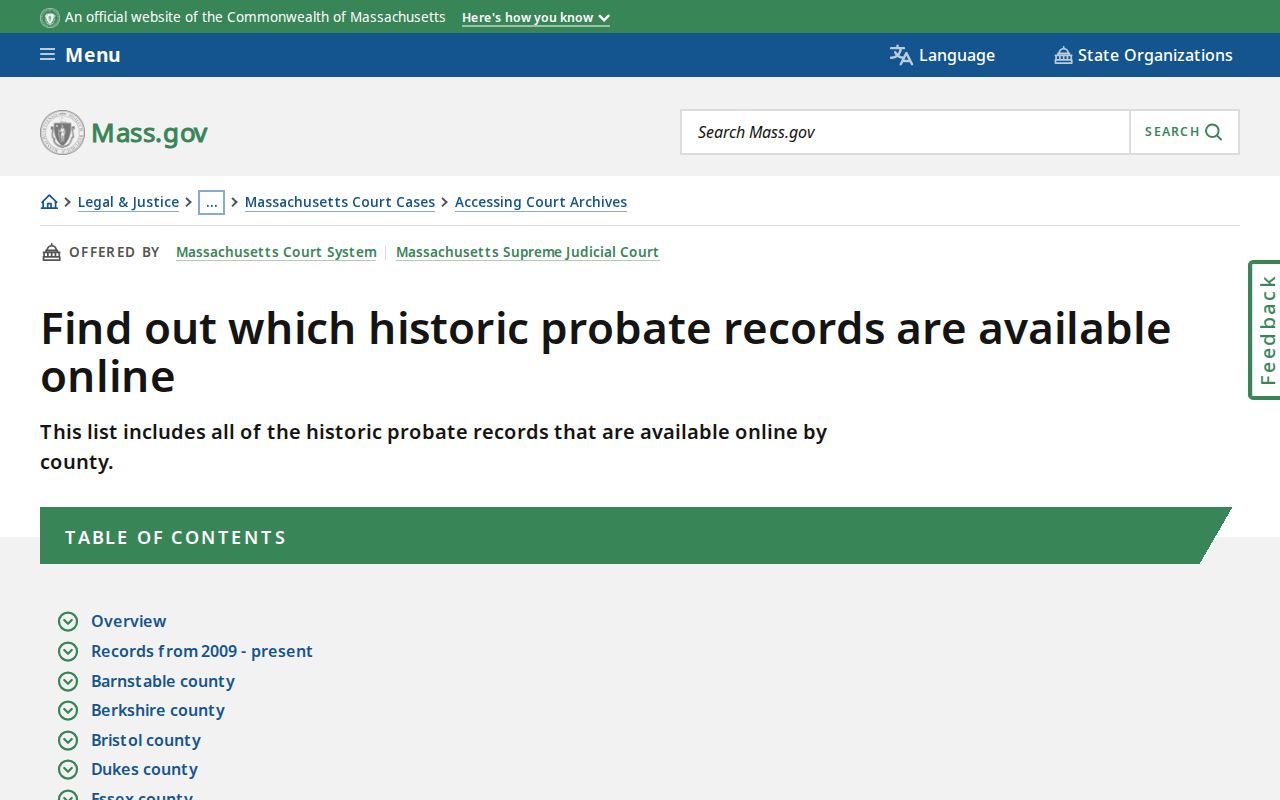
A probate result can point to a decedent, fiduciary, heir, estate, or property transfer question. It is not proof of a person’s current location. The Norfolk Registry, Morrill’s newspapers, cemetery resources, and Society research help test the probate lead against a dated property trail.
Note: Preserve the probate date and case reference before using an estate clue to revisit the Registry deed chain.
Norwood Past Residents on Washington
Norwood was incorporated from South Dedham in 1872. Use South Dedham as an additional place term for older deeds, directories, and newspapers. This matters most when a nineteenth-century clue does not appear under the later Norwood name.
Washington Street needs another adjustment. Historical Society research describes a railroad overpass and route change in 1897, with old Washington Street behind the current area. Its local articles use address numbers, market and business names, directories, Census material, deeds, and family histories. For a number that no longer fits, compare the cross street, business name, owner surname, Sanborn sheet, and legal description.
The address itself may have changed form while the parcel trail survived in a plan or deed. Preserve the original wording as well as the modern address in the research ledger.
Limits on Norwood Address History
Address-history research should state exactly what a source supports. A tax owner may differ from the people who appeared in a directory. A directory may omit a household. A Census schedule records one date. A deed shows a transfer role, while a map shows building context. Protected voters, Address Confidentiality Program participants, non-owner household members, and private account information will not appear as a public address history.
When the evidence does not align, keep the uncertainty. Contact the Norwood Historical Society for assisted research, ask Morrill Memorial Library for collection help, request a specific existing record from the custodian, or report “not located.” A careful dated trail is more useful than a confident but unsupported answer.